
- Advertisement -

Related

Nordic CTAs Stumble Again in Trendless Markets

Powering Hedge Funds

Stockholm (HedgeNordic) – September was the second-worst month of the year for Nordic trend-following quantitative hedge funds, as measured by the NHX CTA, with the group losing 1.5 percent on average (86 percent reported). Financial markets did not offer exploitable trading opportunities for Nordic CTAs, which are down 2.8 percent year-to-date through September.
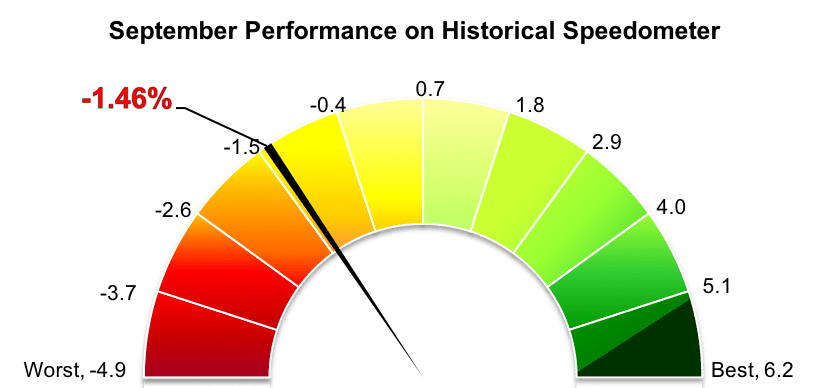
Speedometer: The September performance of the NHX CTA Index relative to its best and worst monthly performance since 2010. Source: HedgeNordic.

International CTA funds performed slightly better than the average Nordic CTA last month, as the Société Générale CTA Index, for instance, fell only 0.6 percent in September. The SG CTA Index, which reflects the performance of the largest 20 CTAs by assets, is down 3.5 percent year-to-date through the end of September. The Barclay BTOP50 Index, however, gained less than 0.1 percent last month, maintaining the year-to-date performance at a negative 2.6 percent. The Barclay index tracks the performance of the 20 largest investment CTA programs. The broader Barclay CTA Index, meanwhile, was down less than 0.1 percent in September, keeping year-to-date losses at 1.4 percent.

Only four members of the NHX CTA reported positive performance for September. Coeli Prognosis Machines, which employs a systematic global macro strategy with the use of artificial intelligence, gained 1.5 percent last month, recouping some of the losses incurred in the first quarter of the year. The fund overseen by Alex Gioulekas is down 8.2 percent so far this year.

Shepherd Energy Portfolio, a managed futures fund focusing on the Nordic power market, is currently enjoying its strongest trading year since launching in March 2004. The fund is up 0.8 percent in September and 13.9 percent year-to-date. Shepherd Energy Portfolio, which returned 36.3 percent in the past three years, is the best performing member of the NHX CTA in 2018.

Innolab Capital Index, another artificial intelligence-powered vehicle, and Nordea 1 – Heracles Long/Short MI Fund tumbled 4.3 percent and 4.2 percent, respectively. Runestone Capital Fund, which trades VIX-related volatility instruments, was down 3.7 percent last month.


Picture © Ismagilov—shutterstock

Subscribe to HedgeBrev, HedgeNordic’s weekly newsletter, and never miss the latest news!

Our newsletter is sent once a week, every Friday.

Eugeniu Guzun
Eugeniu Guzun
Eugeniu Guzun serves as a data analyst responsible for maintaining and gatekeeping the Nordic Hedge Index, and as a journalist covering the Nordic hedge fund industry for HedgeNordic. Eugeniu completed his Master’s degree at the Stockholm School of Economics in 2018. Write to Eugeniu Guzun at eugene@hedgenordic.com

Latest Articles

Core, Satellite, and Structural Premiums: PensionDanmark’s Approach to Emerging Market Debt

Many institutional investors have gradually internalized mandates once awarded to external managers, seeking tighter cost control, greater transparency, and improved alignment. Emerging market debt...

PIMCO: Similar Yields, Better Risk Profile in European High Yield

The U.S. high yield market has long been regarded as the global benchmark: deeper, more liquid, and broader in sector composition. For many allocators,...

Avoiding the Echo Chamber: Kraft’s Playbook in Tighter High-Yield Market

Delivering strong returns during a market rebound is one thing. Preserving performance momentum once spreads tighten and dispersion fades is another. That was the...

Tidan Deepens Volatility Arbitrage Expertise

Tidan Capital has strengthened its volatility and options arbitrage platform with the appointment of Laurent Keller as Senior Portfolio Manager. The Stockholm-based hedge fund...

Two Brothers, One Model, Ten Years: The Evolution of Othania

Exactly ten years ago, two brothers on the outskirts of Copenhagen set out to build their own asset management firm. Their idea was straightforward...

Rare Valuation Gap Between Small and Large Caps

Over the past five years, Swedish small caps have oscillated between a 10 percent premium and a 10 percent discount relative to large caps,...

Allocator Interviews

In-Depth: Diversification

- Advertisement -

Voices

Request for Proposal

- Advertisement -