

Stockholm (HedgeNordic) – One of the main attractions of hedge funds to institutional investors has been their ability to deliver uncorrelated absolute returns. A report published earlier this year, in February, indicates that institutional investors now want their hedge fund managers to “target double bottom-line benefits: do well financially by doing good socially and environmentally.”
The report by a collaboration of industry partners, including AIMA, CAIA, CREATE-Research and KPMG, reflects two separate electronic surveys, one focusing on hedge fund managers and the other on their institutional clients. According to this survey, 55 percent of institutional investors include environmental, social and governance (ESG) considerations as part of the due diligence process before allocating to a hedge fund manager.
Institutional investors expect hedge fund managers to deliver attractive risk-adjusted returns while considering the environmental and social risks associated with their investments. “Thus, the traditional risk-return equation is being rewritten to include ESG factors,” said Anthony Cowell, Head of Asset Management at KPMG in the Cayman Islands and co-author of the report. “In the hedge fund industry, ESG has gone from being a nice-to-have to a must-have.”
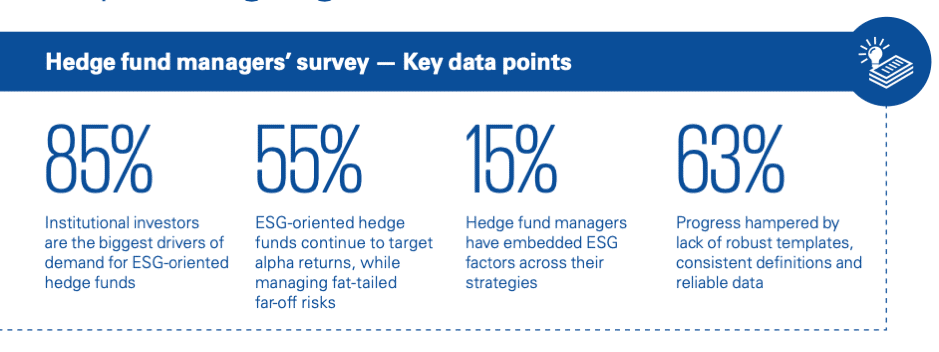
Hedge fund managers, in turn, have stepped up their ESG efforts, with the advance primarily driven by institutional investors and their consultants. According to the hedge fund managers’ survey, 85 percent of survey participants indicate that institutional investors are the biggest drivers of demand for ESG-oriented hedge funds. The report summarising the results of the two surveys also highlights that 59 percent of hedge fund managers are either at the ‘mature’ or ‘in progress’ stage of implementing ESG through appropriate policies, committees, research and data.
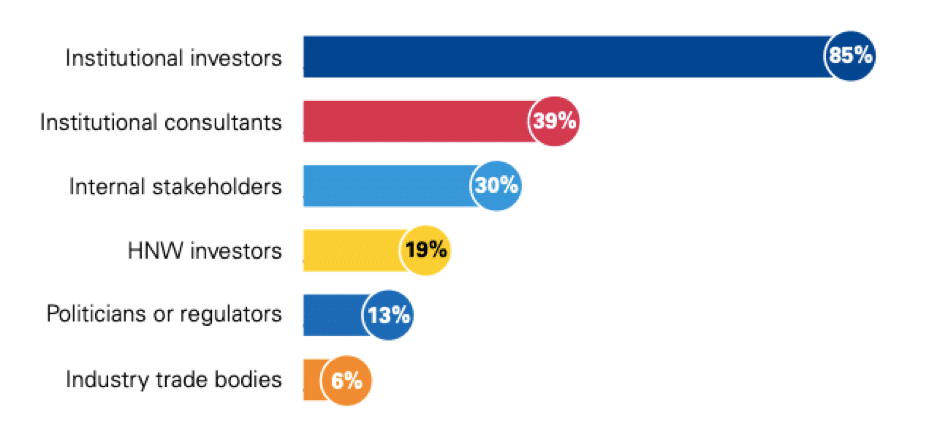
“Recognising that purpose and profit are no longer mutually exclusive, a growing number of institutional investors expect hedge fund managers to incorporate environmental, social and governance (or ESG) factors into their investment activities,” wrote Jack Inglis, the CEO of AIMA, in connection with the publication of the report. “We are not yet able to pronounce unequivocally that ESG-compliant investments will lead to better returns,” acknowledged Inglis. “But every indication, from managers and investors alike, suggests that ESG integration is not just increasingly important, but for savvy managers, it can go hand-in-hand with generating alpha.”
ESG awareness is increasingly extending its footprint in the hedge fund industry, with the heterogeneity of the space also reflected in each manager’s approach to ESG integration. In the process of incorporating ESG factors into their activities, three approaches have been used by at least three in every ten surveyed hedge fund managers, with many of them adopting more than one approach. The first avenue is ESG integration (52 percent), which involves identifying material ESG factors and incorporating them into the investment process. The second avenue is negative screening (50 percent), which involves the exclusion of stocks that sit uncomfortably with the personal values of investors. The third avenue is shareholder engagement (31 percent).
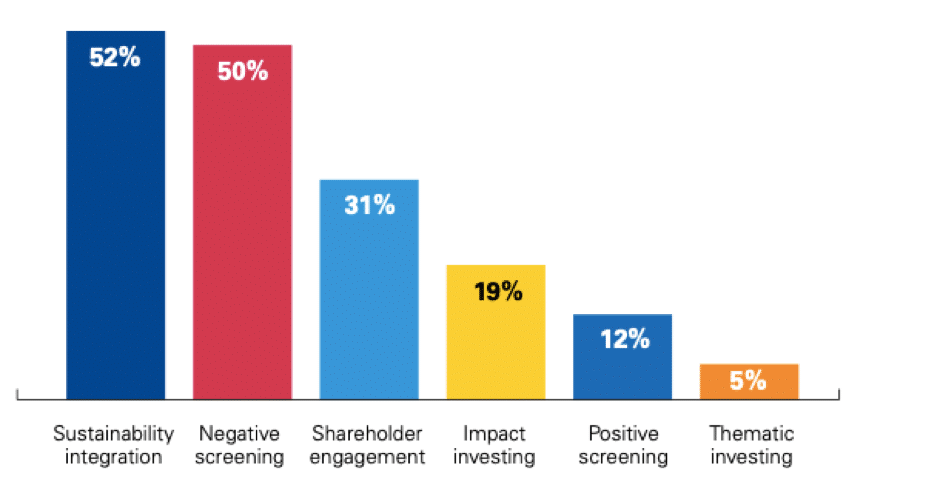
According to the report, shareholder engagement has been gaining traction as companies and their management teams have been slow to react to ESG challenges and opportunities. Shareholder engagement on the part of hedge fund managers can serve two purposes. First, it can enrich their investment process with first-hand knowledge about their underlying investments. And second, shareholder engagement can steer companies into the ESG space through discussion, dialogue and proxy voting.
What Barriers are Holding Back the Pace of Progress?
A lack of quality data is currently the biggest obstacle to the scale of ESG adoption among hedge fund managers. “A number of factors have conspired against progress thus far,” writes the report, which adds that “far and away, the most important one is the lack of quality and consistent data on ESG factors, as cited by 63 percent of our hedge fund respondents.” Another factor that hampers the progress of ESG integration is the confusion over industry terminology. About one in every four hedge fund managers surveyed, meanwhile, indicate that ESG factors are “not relevant to our strategy or mandate.”
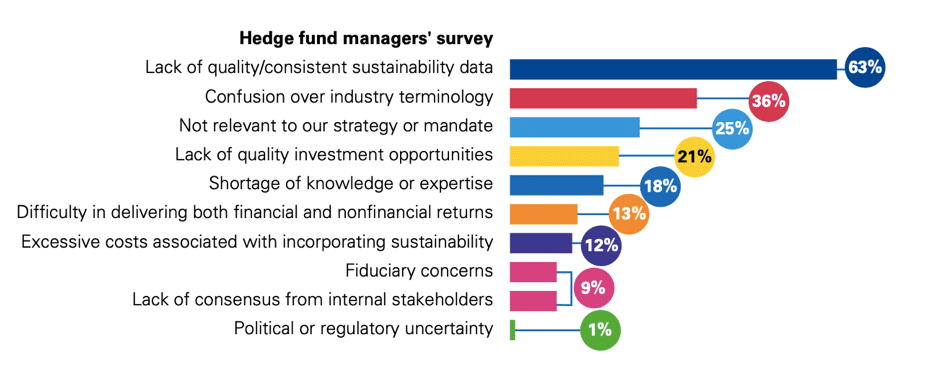
About 18 percent of hedge fund also cited a “shortage of knowledge or expertise” as one big challenge in making ESG-oriented investments. Whereas there might have been a shortage of investment professionals able to combine financial expertise with ESG experience in the early days of ESG, this challenge is increasingly less of a problem. Many hedge fund managers in the Nordics and beyond have been able to hire ESG specialists, even build dedicated ESG teams, and join advisory committees at standard-setting organisations in the ESG space, among other things.
Another challenge relates to the high costs of implementing ESG considerations across the organisation. These costs could relate to investments in talent, investments in data from third-party providers or investments in marketing to help build credibility in the market. According to a Nordic hedge fund manager interviewed in the survey, “small hedge fund managers face excessive costs in implementing sustainability, while large ones have a marketing machine to help greenwash.”
This article featured in HedgeNordic’s report “ESG in Alternative Investments.”
