

Stockholm (HedgeNordic) – The month of February saw hedge funds receive $1.69 billion in capital from investors, ending a five-month streak of consecutive outflows. According to eVestment, capital flows for February represent a key industry bellwether of net flows for the hedge fund industry. Last February’s level of new investment, however, marked the industry’s worst February for net flows in a decade.
Historically, February has been an important month for the hedge fund industry, as new allocations usually start flowing heavily into the industry during this period of the year. In the past ten years, the level of new investment in February amounted to $17 billion on average, significantly above the $1.69 billion in new capital received by the industry last month. In addition, no aggregate outflows from the hedge fund industry have been recorded in the past decade. Coupled with a $20.6 billion increase in assets due to positive performance in February, the industry’s asset under management stand at $3.24 trillion as of the end of February.
Hedge fund strategies that delivered disappointing returns in 2018 suffered the most significant outflows in February and the first two months of 2019. Long/short equity hedge funds registered the largest outflows in 2019, which totaled $6.1 billion. Investors removed an estimated $4.3 billion and $3.3 billion from macro-focused hedge funds and managed futures vehicles in the first two months of the year. Two-thirds of macro and managed futures strategies had redemptions pressures in 2019.
Among hedge fund strategies that received the largest inflows year-to-date, multi-strategy hedge funds received strong new investment for a second consecutive month. Multi-strategy hedge funds received $7.7 billion in new capital in the first two months of 2019. According to eVestment’s latest asset flow report, the ten vehicles with the largest inflows in February returned three percent on average last year, which shows that last year’s good performers are receiving strong investor interest in 2019. eVestment has also observed that investors have a clear preference for larger hedge fund managers when deploying new capital.
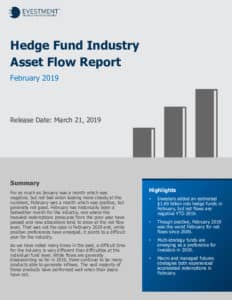
eVestment’s complete Hedge Fund Industry Asset Flow Report can be downloaded below:
Picture © alphaspirit—shutterstock
