
- Advertisement -

Related

Which Hedge Fund Strategies Perform Best in Late-Cycle Phase?

- Advertisement -

Stockholm (HedgeNordic) – Market observers may have different views on where we are in the business cycle, but those finding themselves in a typical slowdown phase of the cycle may be interested in finding out which hedge fund strategies perform best during this phase. In a recently published report, asset manager Fidante Partners lays out an analysis of the behavior of a range of hedge fund strategies during the late stages of a business cycle covering a period of 20 years.

Although every business cycle is different in its own way, the four widely recognized phases of a business cycle are: recovery, expansion, slowdown, and recession. According to Fidante Partners, we are currently in the late stage of a business cycle characterized by flattening or even inverting yield curves and deteriorating growth prospects. Whereas various hedge fund strategies tend to generate similar returns over a long enough period of time, there is huge performance dispersion among strategies in the more challenging environment of a late stage business cycle. Because of more frequent corrections in equity markets and increased market volatility, macro-focused and short-biased hedge funds tend to perform better than their long-term averages in the late stage of business cycles.
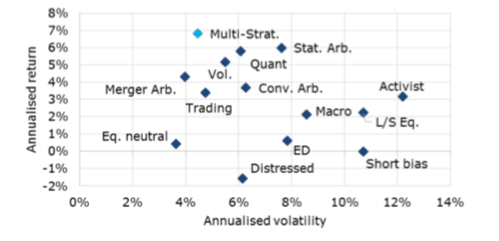
Risk and return of hedge fund strategies in an economic slowdown. Source: Bloomberg, Fidante Partners. Data in US Dollars as at 31 July 2018.

Event-driven and long/short equity strategies, meanwhile, are found to struggle during the late stages of a business cycle as financial markets get choppy. Merger arbitrage, statistical arbitrage, and equity market-neutral hedge funds tend to perform in line with their long-term averages during this stage of a business cycle. That said, equity market-neutral and arbitrage strategies behave as expected in the late-cycle phase. Equity market-neutral hedge funds, for instance, aim to produce returns which are independent of broader equity markets and thus largely independent of changes in growth prospects or interest rates. Returns produced by arbitrage strategies are also expected to be largely independent of the prevailing interest-rate environment and growth prospects.

Merger arbitrage, statistical arbitrage, quantitative and volatility hedge fund strategies are found to deliver superior risk-adjusted returns across the entire cycle, with this subset of strategies also performing strongly during the late stage of a business cycle.
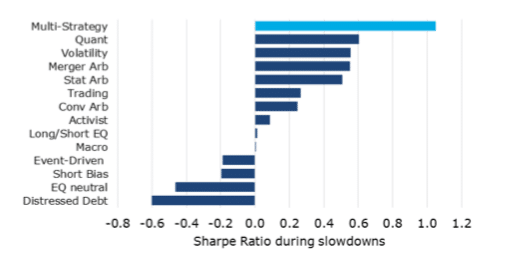
Risk-adjusted returns of hedge fund strategies in an economic slowdown. Source: Bloomberg, Fidante Partners. Data in US Dollars as at 31 July 2018.

The paper titled “Hedge funds in the late stages of a business cycle” can be found below:
Picture © leungchopan—shutterstock.com

Subscribe to HedgeBrev, HedgeNordic’s weekly newsletter, and never miss the latest news!

Our newsletter is sent once a week, every Friday.

Eugeniu Guzun
Eugeniu Guzun
Eugeniu Guzun serves as a data analyst responsible for maintaining and gatekeeping the Nordic Hedge Index, and as a journalist covering the Nordic hedge fund industry for HedgeNordic. Eugeniu completed his Master’s degree at the Stockholm School of Economics in 2018. Write to Eugeniu Guzun at eugene@hedgenordic.com

Latest Articles

HSBC’s Three Decades of Building Hedge Fund Portfolios

Hedge fund investing has become increasingly institutionalized and resource-intensive, requiring access to specialized managers alongside deep due diligence, portfolio construction, risk management, and ongoing...

The Benefits of Multi-Manager Portfolios in CTA Investing

At first glance, CTA investing can appear deceptively homogeneous. Many managers trade the same liquid futures markets and rely on systematic, trendfollowing models that...

Why Some Nordic Allocators Prefer Multi-Strategy Hedge Funds

Many institutional allocators spend years building portfolios of single-strategy hedge funds across different asset classes, geographies, and investment styles. Yet there is also a...

Allocators Seek Sharpe, Not Spectacle When Opting for Multi Managers

Global allocators are once again paying closer attention to multi-strategy and multi-manager hedge fund solutions. But unlike the years before the financial crisis, the...

Swiss Family Office Seeks $5 Million Allocation to Liquid Alternatives

A Swiss family office is seeking to allocate $5 million to liquid alternative investment strategies, including hedge funds, managed futures, commodities, and funds providing...

OP’s R2 Crystal Sees Stronger Case for Hedge Funds

For much of the past decade, hedge funds struggled to compete against strong beta-driven markets fueled by ultra-low interest rates and abundant liquidity. But...

Allocator Interviews

In-Depth: Diversification

- Advertisement -

Voices

Request for Proposal

- Advertisement -