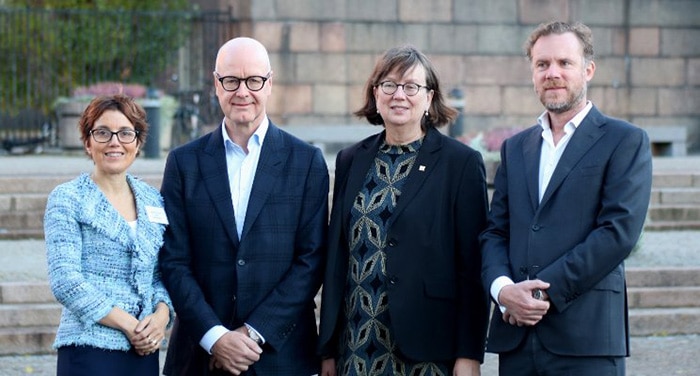

On 17 November the Brummer & Partners MathDataLab at the Department of Mathematics at the KTH Royal Institute of Technology in Stockholm was inaugurated. The goal is to create a hub for mathematical research into complex data analysis.The initiative has been made possible through a SEK 15.5 million research grant to KTH from Brummer & Partners.
KTH is now building up a research environment and has succeeded in attracting leading international names to the laboratory with a research focus on complex data analysis, a partly new field of research for Sweden. The research has the potential to break new ground, although the results are uncertain and could take many years to materialise.
The director of the laboratory that is now being established at the Department of Mathematics is Professor of Mathematics Henrik Hult. KTH has enlisted two of the world’s leading researchers in the field – Konstantin Mischaikow, Professor of Mathematics at Rutgers University, and Per-Gunnar Martinsson, Professor of Mathematics at the University of Oxford – who will become affiliated professors at the laboratory. The recruitment of post-docs is underway with appointments scheduled for 2018. The research grant covers a period of at least five years. The scientific focus has been initiated by KTH and is entirely independent from Brummer & Partners’ interests and activities.
“This is about advanced mathematical research that is of strategic importance for KTH and Sweden. Technological advances in areas like AI and machine learning are so rapid that we do not always know why it works or doesn’t work, and that’s where mathematics enter the picture. Improving our understanding of how to analyse complex data could have a big impact in completely different applications, including cancer treatment, image recognition and self-driving cars,”
Professor Henrik Hult, Director of the Brummer & Partners MathDataLab.
The research grant to KTH forms part of Brummer & Partners’ long-term social commitment to mathematics. In addition to KTH, Brummer & Partners is also supporting projects aimed at secondary school teachers through the Klein Days training event and secondary school students with an interest in mathematics through the School Mathematics Competition.
“Sweden has fundamentally a very strong tradition in mathematics research that we will continue to build on. We are particularly pleased that our support has enabled KTH to attract leading international researchers to the Brummer & Partners MathDataLab”
Brummer & Partners’ CEO, Ola Paulsson