

By Alexandra McGuigan, Head of APAC, Qblue Balanced: Over the past year, pension funds, sovereign investors and family offices across Asia-Pacific and Europe have been inviting Bjarne Graven Larsen, founder of Qblue Balanced and former CIO of ATP and Ontario Teachers’ Pension Plan, into closed-door sessions to look at their portfolios. The questions vary. The one question that now comes up in almost every room does not vary. It is inflation, and it usually arrives with a slightly embarrassed preamble: we have not really thought about this since the 1990s.
They are in good company. Since 2020 the world has delivered four supply-driven inflation shocks in six years: COVID lockdowns and broken supply chains, Russia’s invasion of Ukraine and the energy shock that followed, the Liberation Day tariffs of 2025, and this year’s war in Iran. The great moderation, four decades of low and predictable inflation, has quietly given way to something more volatile. And the portfolio most institutions still run was built for the old climate.
A Bet on One Box
Bjarne usually starts these meetings by pointing out one simple thing, it is a four-box grid, growth against inflation. A bond-equity portfolio, he explains, is an implicit bet on a single weather forecast: growth rising, inflation falling. In the opposite box, low growth and rising inflation, both legs give way at once.
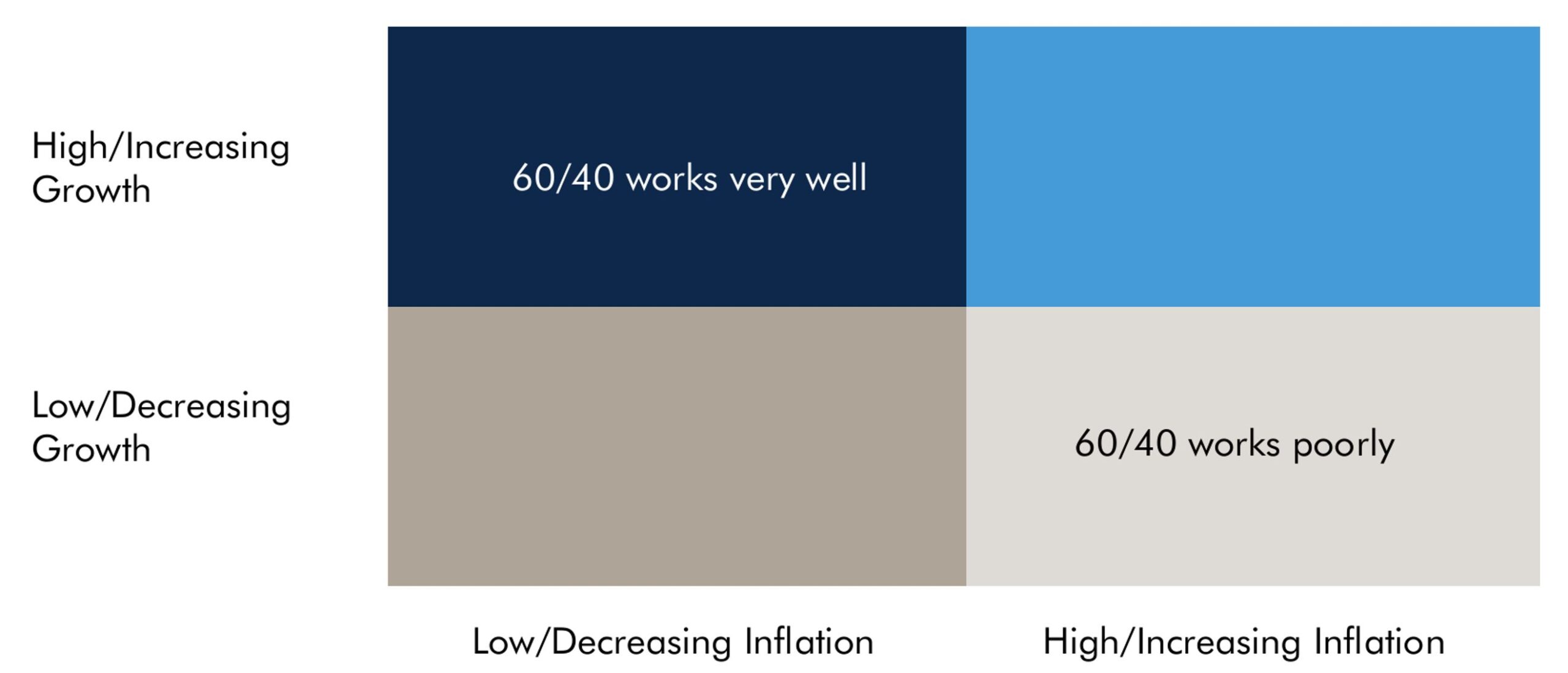
“The 60/40 portfolio worked really well in the great moderation, from the mid-1980s until 2019 or 2020,” he says. “It has been challenged in the past few years, and we cannot expect it to work as well going forward. So you need diversification.” The history is best read in real terms. Across the eight US inflationary regimes since 1926 identified by Neville, Draaisma, Funnell, Harvey and Van Hemert (2021), 60/40 lost about 6 per cent a year in real terms; from 1960 to 2025 it earned 9.3 per cent a year when inflation was low and nothing when it was high. Fama and Schwert (1977) and Campbell, Sunderam and Viceira (2017) documented the mechanism decades before 2022 reminded everyone of it. “There is no doubt that you have the most need to protect yourself against supply-driven inflation shocks, the ones that are also linked to geopolitical risk,” Graven Larsen told an ICPM audience of pension executives. Inflation protection, in other words, is geopolitical resilience wearing a different badge.
Two Ways to Diversify
The answer he gives is always the same, and by all accounts it is the part of the meeting where the note-taking starts. “There are really two ways you can diversify. You can diversify into something that is uncorrelated; that is alternative risk premia. Or you can diversify into something that actually takes out some of the unwarranted inflation sensitivity in your bond and equity portfolio. That is a different way of thinking about diversification: having something with negative correlation to bonds and equities when you really need it.” The first route Graven Larsen set out in these pages in June. The second is a fourth building block, an inflation protection portfolio, and it is where the cleverness lives.
Why the Obvious Hedges Disappoint
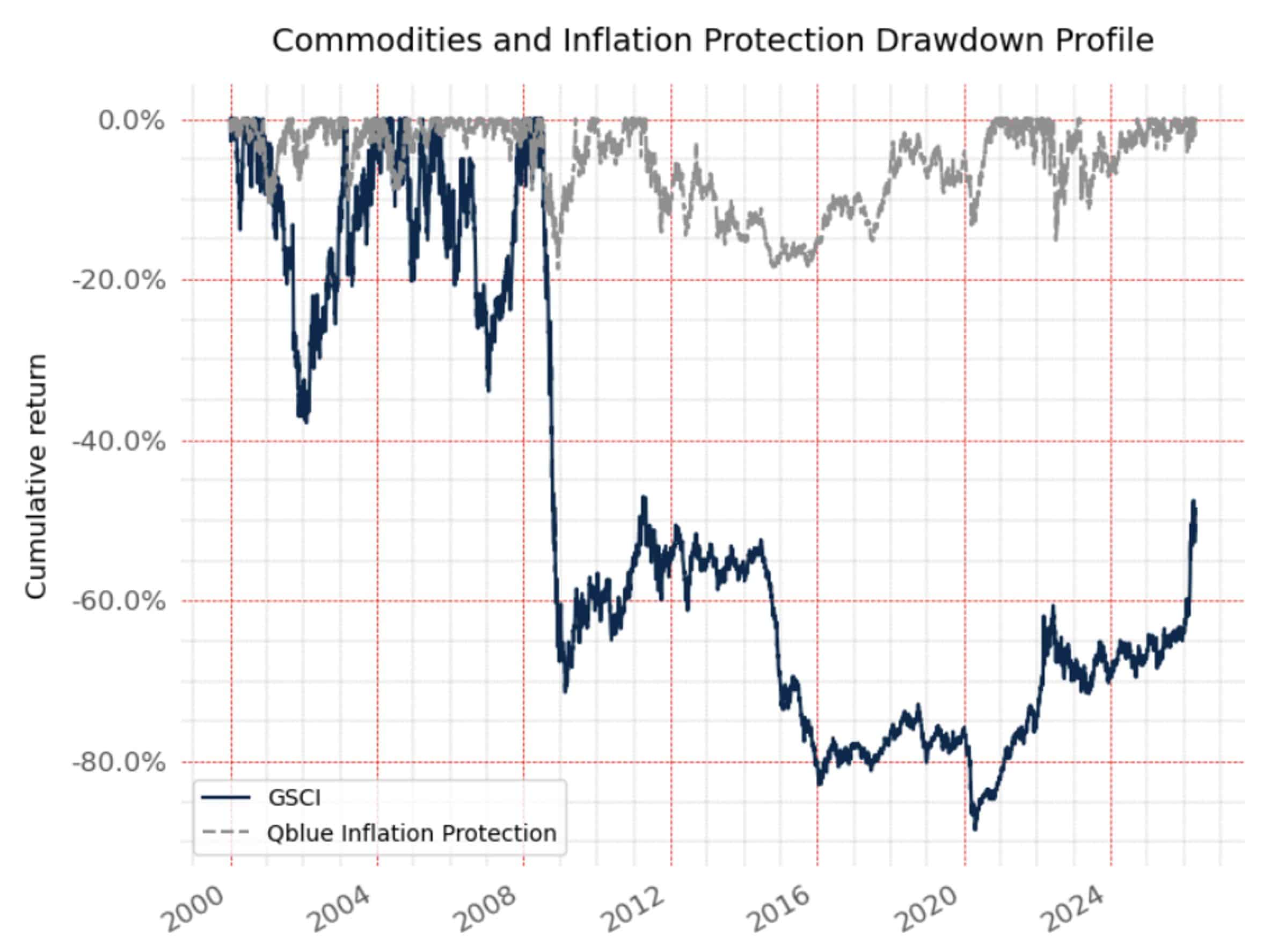
Most allocators have tried the obvious. Buy a commodity index, add some inflation-linked bonds, wait. The trouble is that the obvious hedge is a snow shovel bought in Singapore: you pay to store it every year and, when it finally snows, it turns out to be the wrong shape. A passive long-only commodity index peaked in 2008, sat more than 80 per cent below that high by March 2020, and has still not recovered. “TIPS, maybe a surprise to some people, tend not to do so great when inflation spikes,” Graven Larsen says. “You end up with a real rate exposure, and real rates tend to go up in inflationary periods.” 2022 proved the point. Gold, meanwhile, returned 61 per cent in the 1970s but fell 14 per cent post-COVID. It hedges central bankers losing the plot, not every rise in the oil price.
The Clever Part
“If you just buy long-only commodities and breakevens, you can lose a lot of money, like you did between 2015 and 2019, when inflation went south and oil prices went south as well,” Graven Larsen says. “You have to do it in a smart way.” Smart, in his design, means five building blocks and a dynamic overlay on each. Strategic commodity exposure, energy-led, provides the raw inflation beta; a long/short commodity strategy trading momentum, carry and value sits on top of it. Inflation swaps in the US and Europe carry the breakeven exposure, with the two-year position sized by a momentum signal so that the portfolio keeps almost all of its sensitivity to rising inflation with far less volatility. Gold covers monetary credibility. And a monetary policy strategy reads the central bank’s reaction function, positioning in rates and the curve for the tightening that supply-driven inflation eventually forces. Risk, not capital, is budgeted across the five.
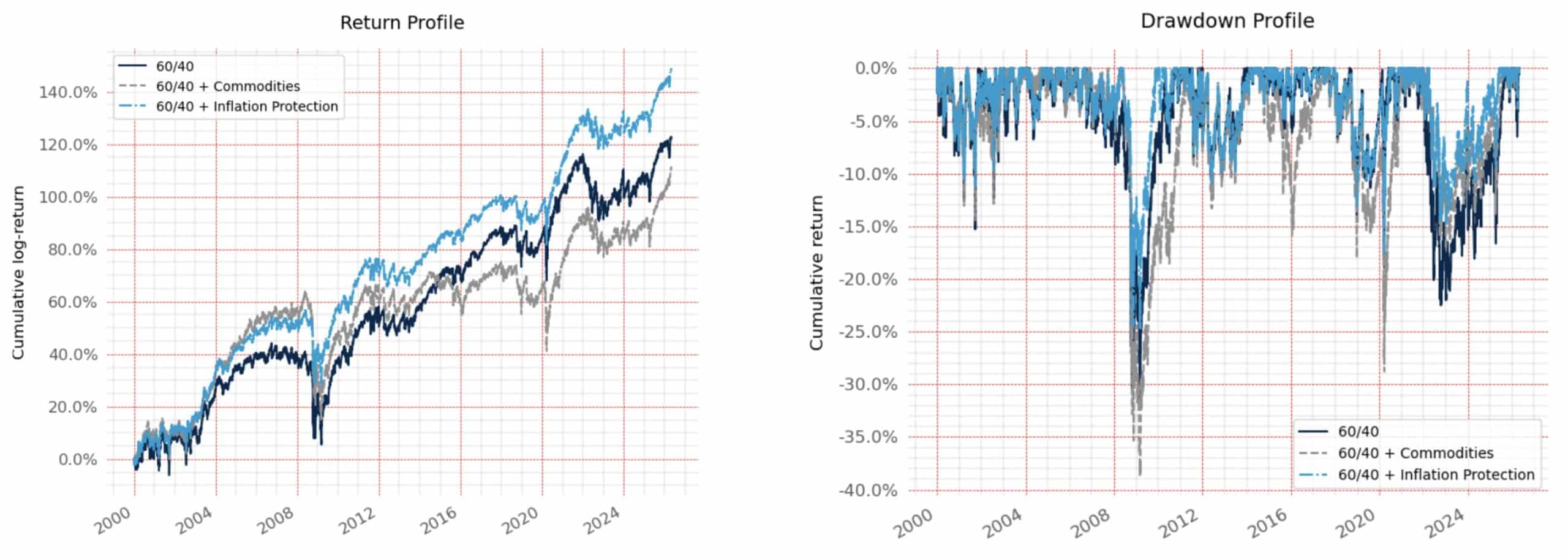
The result is a portfolio that does what a static hedge cannot. From 2010 to 2026 it earned 7.3 per cent a year above cash at 9.8 per cent volatility, a Sharpe ratio of 0.75, moving sideways in the quiet years and stepping up sharply in 2021–22 and again in 2026. Its worst drawdown over the period was under 20 per cent, against more than 80 per cent for the commodity index. Moved into a 60/40 at 20 per cent of capital, it beat both the plain 60/40 and a 60/40 with commodities, with shallower drawdowns.
Governance, in Graven Larsen’s design, is part of the engineering. “Boards and investment committees often do not have the stamina to stomach periods of drag. People have tended to take off their strategies at the worst possible time.” A block with a positive expected return is far harder to shoot than one that charges a premium, and his advice to several pension plans has been to house it inside the fixed income allocation, as the price of holding nominal bonds, rather than in a box of its own where it becomes a target.
A Recipe Tested in Real Life
This year has been the test. As the Iran war pushed energy prices higher, bonds have been suffering and lately equity markets has started to move sideways. “Since mid-June 2026, where Qblue launched the Total Portfolio fund you have not earned one single dollar on the 60/40 portfolio, while we are up 10 per cent,” Graven Larsen says of the combined portfolio that pairs an equity and bond core with ARP and the inflation block. “With zero return in the equity and bond buckets, we are still up 10 per cent, and it is quite diversified.”
The Bottom Line
The 60/40 portfolio is not dead. But it is a bet on one box of a four-box world. What Graven Larsen does in room after room is refuse to forecast the box and instead remove the exposure to it, systematically, with positive carry, inside a total portfolio approach. He puts it plainly: “Every time I have taken a risk decision, it has turned out to be tactically correct. Every time I have taken a tactical view, it has turned out to be wrong. If you spend all your time discussing whether there is going to be inflation, instead of focussing on the consequences, if there is inflation, you will never get anything done.”
Key Academic References
Campbell, J.Y., Sunderam, A. & Viceira, L.M. (2017). Inflation Bets or Deflation Hedges? The Changing Risks of Nominal Bonds. Critical Finance Review, 6(2).
Fama, E.F. & Schwert, G.W. (1977). Asset Returns and Inflation. Journal of Financial Economics, 5(2).
Ilmanen, A. & Kizer, J. (2012). The Death of Diversification Has Been Greatly Exaggerated. Journal of Portfolio Management, 38(3).
Molenaar, R., Sénéchal, E., Swinkels, L. & Wang, Z. (2024). Empirical Evidence on the Stock–Bond Correlation. Financial Analysts Journal, 80(3).
Neville, H., Draaisma, T., Funnell, B., Harvey, C.R. & Van Hemert, O. (2021). The Best Strategies for Inflationary Times. Journal of Portfolio Management, 47(8).
Graven Larsen, B. (2026). Beyond 60/40: The Case for Liquid, Systematic Diversification. HedgeNordic, June 2026
About the Author: Alexandra McGuigan is Head of APAC at Qblue Balanced, a Copenhagen-based systematic and sustainable asset manager founded in 2018 by Bjarne Graven Larsen, former CIO of ATP and Ontario Teachers’ Pension Plan. Qblue Balanced manages over USD 2 billion for institutional investors globally.
Disclaimer: This article is for informational purposes only and does not constitute investment advice or an offer to buy or sell any financial instrument. Past performance is not a guarantee of future results. Historical inflation-episode and inflation protection strategy statistics are back-tested, partly using US data (S&P 500, 10-year Treasuries), and may differ materially from live results. Live performance referenced reflects portfolios managed by Qblue Balanced A/S.
