
- Advertisement -

Round Table: Operational Challenges

The role of the Chief Operating Officer in asset management continues to expand, as operational challenges grow in both scope and complexity. Once centred primarily on trade processing and operational control, the function now sits at the intersection of technology strategy, regulatory interpretation, data governance, vendor management, and increasingly, judgment around what should be automated, outsourced, or retained in house. As a result, COOs now work more closely than ever with their technology and service providers, relying on them not just for infrastructure and execution, but as partners in navigating change.

Against this backdrop, HedgeNordic, together with IG Prime and Clearwater Analytics (CWAN), convened the Nordic COO Roundtable in Stockholm to explore the operational challenges facing Nordic asset managers today.

Nordic COO Roundtable Write Up

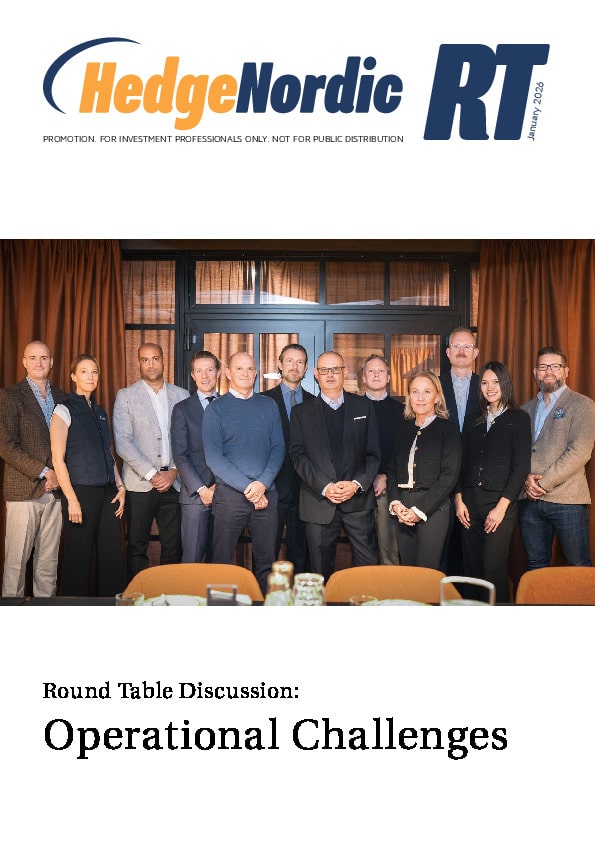
The roundtable brought together senior operational leaders from across the hedge fund and alternative investment landscape, alongside key technology and service providers that increasingly shape how investment operations function in practice. Participants included Catharina Östring of Coeli, Katarina Carlbring of Nordkinn Asset Management, Petter Mattsson of Alcur Fonder, David Bergquist of Volt Capital Management, Daniel Mackey of Protean Funds Scandinavia, Martin Redgård of Finserve, Grant Loon of VHC Partners, as well as Ahmed Patel of IG Prime and Stephen Roberts of Clearwater Analytics. The discussion was moderated by Andi Woolass of CWAN.

The conversation moved deliberately away from theory and into day to day operational reality. Topics ranged from trade lifecycle efficiency and straight through processing to the growing burden of regulation, including DORA, MiFID and liquidity management tools. Participants compared approaches to data ownership, data quality, and the practical limits of relying on single providers versus broader vendor ecosystems. Separately managed accounts featured prominently, both as a growth tool and as a source of operational complexity. The group also explored the cautious adoption of artificial intelligence, distinguishing between genuine use cases and technology that remains premature for mission critical workflows.

What emerges from the discussion is not a prescribed model, but a candid snapshot of how experienced COOs, working closely with their technology and service partners, are thinking, prioritising, and adapting as operational challenges continue to evolve.

The full roundtable write up captures this exchange in detail, offering insight into how Nordic operational leaders are navigating complexity while maintaining control, resilience, and flexibility.
thumbnail of COO RT 2025

Photography by: Binniam Eskender

Subscribe to HedgeBrev, HedgeNordic’s weekly newsletter, and never miss the latest news!

Our newsletter is sent once a week, every Friday.

HedgeNordic Editorial Team
This article was written, or published, by the HedgeNordic editorial team.

Latest Articles

Beyond 60/40: The Case for Liquid, Systematic Diversification

By Bjarne Graven Larsen: For decades during the great moderation, the 60/40 portfolio was the institutional investor's Swiss army knife. Equities grew wealth; bonds...

Aspect Capital’s Evolving Approach to Chinese Futures

Chinese futures in general add substantial diversification benefits to global futures - and the Chinese commodity futures that dominate certain Aspect Capital strategies also...

Systematic Merger Arbitrage in 2026: Why a Rules-based Approach Matters More Than Ever

By Scott Schefrin, Portfolio Manager at AB Hedge Fund Solutions: After a series of slower years for deal activity, merger arbitrage has re-emerged as a compelling strategy...

Not So Lazy Prices

By Liam Hynes, PhD – S&P Global Market Intelligence: Systematic investing has always been a story of expanding information sets. Prices, then fundamentals, then...

The Hidden Beta in LLM Recommendations

By Victor Brassart and Dan Edelstein at Hafnium: As LLMs become useful in coding, copywriting, and even mathematics, it is natural to ask whether...

Edge Hunting Across Eras

“I have always looked for an advantage or an edge in markets, and I still do,” says Peter Warren. Over more than four decades...

Private Markets

Direct Lending Goes Through First Proper Credit Cycle 

After years of explosive growth and strong returns, private credit is facing its first meaningful stress test, particularly within direct lending, which has become...

More Unknowns, More Dispersion in Private Equity

Private credit managers with exposure to software companies recently faced investor withdrawals as concerns mounted over how artificial intelligence could disrupt parts of the...

Private Equity No Longer Optional as Value Creation Moves Behind Closed Doors

As businesses stay private for longer, an increasing share of value creation now happens away from public exchanges, forcing investors to rethink where they...

Litigation Finance Emerges as an Uncorrelated Corner of Private Markets

Private markets have expanded far beyond traditional private equity, private credit, and infrastructure investing. Among the more specialized corners of the alternatives universe sits...

A Decade of Thematic Private Equity: Summa Equity Sees Stronger Tailwinds Than Ever

While parts of the private equity industry have faced a challenging dealmaking environment in recent years, Nordic mid-market buyout manager Summa Equity has navigated...

Beyond Traditional Fixed Income: Why Aegon AM Sees Opportunity Across ABS and CLO Markets

Every day, households borrow money to buy homes, finance cars, pay for education, or fund everyday consumption. These mortgages, auto loans, consumer loans, and...

Financing the Energy Buildout: The Growing Role of Infrastructure Credit

Infrastructure has traditionally been viewed as one of the more defensive corners of private markets, characterized by essential services, stable cash flows, and hard-asset...

Private Markets Are Not the Problem

Formue is the largest privately owned wealth management firm in the Nordics, overseeing and advising on a total of NOK 250 billion with 425...

Latest Articles

Beyond 60/40: The Case for Liquid, Systematic Diversification

By Bjarne Graven Larsen: For decades during the great moderation, the 60/40 portfolio was the institutional investor's Swiss army knife. Equities grew wealth; bonds...

Aspect Capital’s Evolving Approach to Chinese Futures

Chinese futures in general add substantial diversification benefits to global futures - and the Chinese commodity futures that dominate certain Aspect Capital strategies also...

Systematic Merger Arbitrage in 2026: Why a Rules-based Approach Matters More Than Ever

By Scott Schefrin, Portfolio Manager at AB Hedge Fund Solutions: After a series of slower years for deal activity, merger arbitrage has re-emerged as a compelling strategy...

Not So Lazy Prices

By Liam Hynes, PhD – S&P Global Market Intelligence: Systematic investing has always been a story of expanding information sets. Prices, then fundamentals, then...

The Hidden Beta in LLM Recommendations

By Victor Brassart and Dan Edelstein at Hafnium: As LLMs become useful in coding, copywriting, and even mathematics, it is natural to ask whether...

Edge Hunting Across Eras

“I have always looked for an advantage or an edge in markets, and I still do,” says Peter Warren. Over more than four decades...
- Advertisement -