

Finland’s commercial real estate market is offering investors an unusual combination of discounted entry prices, limited competition and access to properties that would rarely come to market under normal conditions. Helsinki Capital Partners believes the resulting dislocation creates an opportunity for investors able to commit fresh capital. Through its HCP Bricks Fund, the boutique is targeting selected commercial properties, primarily in Helsinki, with a strategy built on low acquisition prices, active asset management and the potential to improve occupancy and valuations.
A market with few active buyers
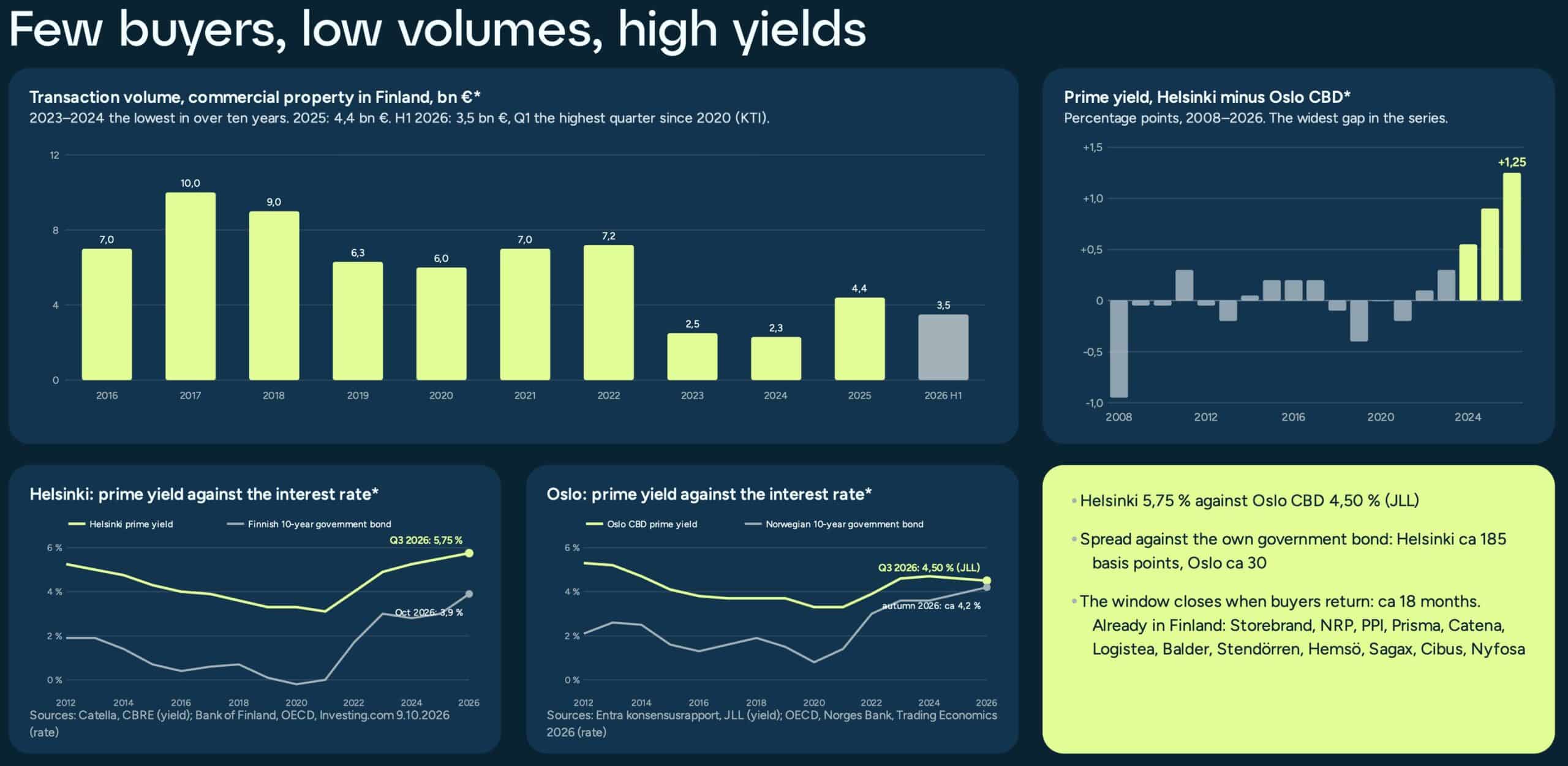
The Finnish commercial property market is still adjusting to the end of the exceptionally low interest-rate environment. Higher financing costs, changing demand for office space and pressure on valuations have made it difficult for some owners to sell at prices reflecting current market conditions. Several open-ended real estate funds have gated redemptions, limiting their ability to meet withdrawal requests and adding to the constraints on the market.
“A large part of the commercial real estate market is held in funds that have gated redemptions. They are not willing to sell at current market prices and recognize the necessary markdowns.”
Tommi Kemppainen, CEO of Helsinki Capital Partners.
For HCP Bricks, the market dislocation has opened a window to pursue deals with less competition. “A large part of the commercial real estate market is held in funds that have gated redemptions. They are not willing to sell at current market prices and recognize the necessary markdowns, so they have gated,” says Tommi Kemppainen, CEO of Helsinki Capital Partners. “Only a few of us have raised money and started investing without owning assets bought at the old prices. As a result, we are seeing a lot of deal flow because appetite for commercial real estate is limited at the moment.”
Buying below replacement cost and unlocking occupancy
Building its portfolio from scratch also means HCP Bricks can acquire assets at current market prices without having to protect legacy valuations. One of the recent acquisitions by HCP Bricks, Bolero Business Park, illustrates the opportunity. Located around ten minutes by train from central Helsinki, the property had slightly more than 30 percent occupancy when HCP Bricks acquired its stake. Kemppainen believes that increasing occupancy alone could potentially double the property’s valuation, with scope for a greater increase if operating performance improves further.
The low entry price gives the fund flexibility when negotiating with tenants. Owners that acquired similar properties at higher valuations may be reluctant to reduce rents, since doing so could force them to mark down their assets. “Owners carrying this type of property at old valuations, such as 2021 levels, cannot easily lower rents. If they do, they may have to write down the properties,” Kemppainen explains.
HCP Bricks does not face the same constraint. It acquired one of the three buildings at approximately €350 per square meter, allowing it to offer more competitive rents while seeking an attractive return on its investment. “We have no problem reducing rents. It is an unusually favourable situation in this asset class,” he says.
A selective focus on Helsinki
Although Finland has a broad commercial property market, HCP Bricks is concentrating on a relatively narrow segment. So far, the fund has focused almost exclusively on Helsinki, where Kemppainen believes the most compelling opportunities are available. “Finland is a huge country. Given the current conditions in commercial real estate, we have not even looked beyond Helsinki,” he points out.
“Finland is a huge country. Given the current conditions in commercial real estate, we have not even looked beyond Helsinki.”
Tommi Kemppainen, CEO of Helsinki Capital Partners.
Within Helsinki, the fund favors prime central business district locations and buildings with attractive fundamentals. One example is Uschakoff House, a historic property on Pohjoisesplanadi. “This is the best street in the country. The building is around 220 years old. In normal economic conditions, there would be no way to buy something like this,” observes Kemppainen.
Helsinki Capital Partners’ figures point to a substantial valuation gap between Finnish commercial property and assets in other Nordic capitals. Its investment in the Uschakoff House, representing 2,578 square meters, has a gross asset value of €4,800 per square meter. HCP compares this with market transactions involving Repslagaren 34 in Stockholm, which sold in January 2026 for approximately €14,500 per square meter, and Stortorvet 7 in Oslo, which sold in March 2024 for around €7,000 per square meter. The properties differ in location and characteristics, but HCP says they are comparable in quality and occupy prime streets in their respective cities.
Building a diversified portfolio through property stakes
HCP Bricks currently holds stakes in three buildings, alongside an investment in a listed real estate company that provides liquidity ahead of further acquisitions. Rather than buying entire properties, the fund prefers partial ownership stakes. Kemppainen argues that this approach can support both diversification and liquidity by creating a pool of investors who may transact in the same asset.
“If other investors own parts of the same building, there is a group of investors with whom you can transact. That provides another layer of liquidity and also helps with diversification.”
Tommi Kemppainen, CEO of Helsinki Capital Partners.
“If other investors own parts of the same building, there is a group of investors with whom you can transact,” he explains. “That provides another layer of liquidity and also helps with diversification.” Partial ownership allows the fund to spread capital across more properties rather than concentrate it in a few wholly owned assets.
The fund also offers quarterly subscription and redemption opportunities, with the possibility of redemptions in kind. In practice, investors can receive property interests valued using the same third-party valuations applied in calculating the fund’s net asset value. This provides an alternative to a cash redemption.
A window to deploy capital
Kemppainen regards the next 18 months as an important period for investing in Finnish commercial real estate. HCP Bricks is examining four additional buildings and expects to acquire at least three more over the next 18 months. “We need more investors so that we can continue reviewing properties coming to market and selecting the best opportunities,” he says. “We are not buying the market as an index or investing in a broad theme. We are very selective within this entry point.”
Kemppainen argues that low acquisition prices and the potential for positive cash flow from the outset can support returns, while a broader economic recovery would provide additional upside. He also believes that an end to the war in Ukraine would increase tourism and business activity in Finland. Increased defense spending is another source of support for the Finnish economy that will be there independently of geopolitics. “On the defense side, substantial resources will also be allocated in Finland, particularly given the country’s long NATO border to the east. This is driving considerable infrastructure investment, which will naturally feed through into broader economic activity, including demand for office space,” Kemppainen says.
“If you get the entry point right, the details matter afterwards, but the price you pay at the beginning is crucial.”
Tommi Kemppainen, CEO of Helsinki Capital Partners.
For Kemppainen, however, valuation remains the decisive factor. He recalls how Helsinki Capital Partners benefited from investing in US real estate after the global financial crisis and in Spanish property-related companies during the country’s downturn in 2014. “The entry point matters enormously,” he concludes. “If you get the entry point right, the details matter afterwards, but the price you pay at the beginning is crucial.”
