
- Advertisement -

Related

Are We in for a Soft Landing?

- Advertisement -

 The Federal Reserve (the Fed) has undoubtedly caused many U.S. recessions over time when attempting to fight inflation through tighter monetary policy. However, sometimes it has engineered so-called “soft landings” whereby inflation slows and real growth continues. How likely is a soft landing in this cycle? 
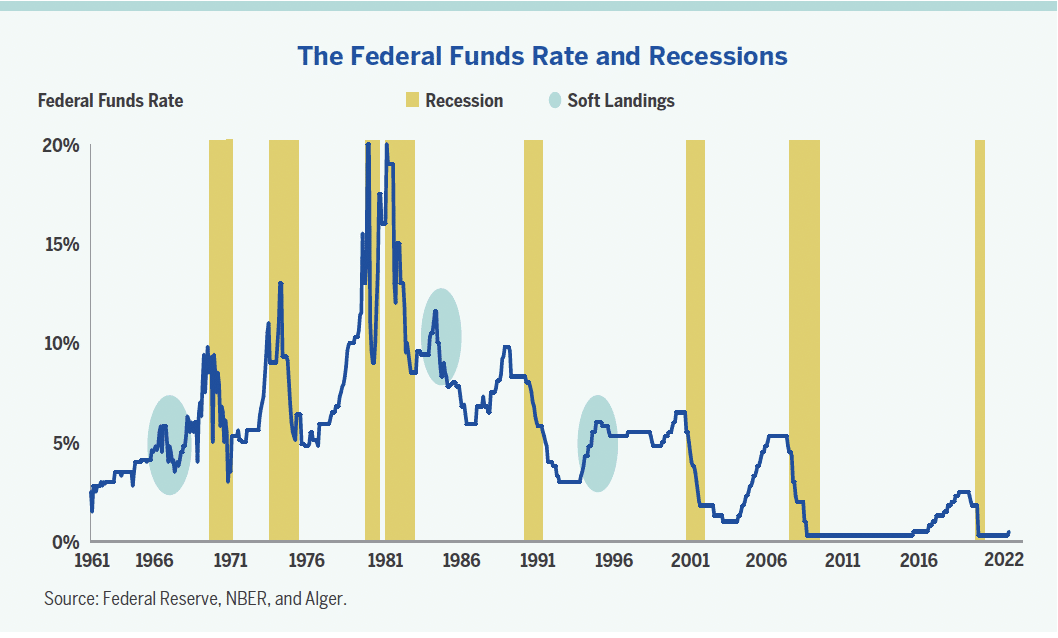
 As shown above, most of the times when the Federal Funds rate rises, a recession follows – “hard landings.” However, the circled areas show when the Federal Reserve raised interest rates, but a recession did not follow – “soft landings.” 

In all three cases, the Fed tightened 300 basis points or more, but economic growth continued. That amount of tightening is about what is anticipated by the Fed’s own projections released in March. Note that the Fed also tightened materially from 2015 to 2018 with the economy growing solidly in 2019, only to be upended by the pandemic. 

At a time when the Fed appears to be increasingly hawkish on inflation, it may be comforting to know that monetary tightening doesn’t always lead to recession and that soft landings have been kind to investors in recent history. Indeed, in the 12-months following the end of Fed tightening in 1985 and 1995 as well as after the Fed relented in 2018, equities generated double-digit returns. 


A piece written by Alger – a La Française partner firm. La Française AM Finance Services, in accordance with the terms of an agreement signed with Alger Management, Ltd, is a distributor of the Alger SICAV in Europe.


Title Pic by pixabay.com

Subscribe to HedgeBrev, HedgeNordic’s weekly newsletter, and never miss the latest news!

Our newsletter is sent once a week, every Friday.

HedgeNordic Editorial Team
This article was written, or published, by the HedgeNordic editorial team.

Latest Articles

Alcur Elevates Flöstrand to CIO One Year After Joining

Stock-picking boutique Alcur Fonder has appointed Per Flöstrand as Chief Investment Officer, with the portfolio manager taking over the role from co-founder and long-time...

Month in Review – March 2026

After a solid start to 2026, following three consecutive years of strong performance, March proved to be a sharp setback for Nordic hedge funds....

Archipelago Adds Firepower After Back-to-Back Strong Years

Archipelago Investments is strengthening its investment team with the appointment of Anders Fagerlund as Senior Analyst and Head of Research. Bringing 15 years of...

From Zero Rates to Volatility: Excalibur at 25

Around the same time last year, Lynx Asset Management marked the 25-year anniversary of its flagship strategy. This April, it is Excalibur Asset Management’s...

Two Allocators, One View: Liquidity, Cost and Control Behind CTA ETF Adoption

On the surface, Morten Christensen, Chief Financial Officer at Norwegian family office Aars, and Jonas Thulin, Chief Investment Officer at Sweden’s AP3, may appear...

Maybe CTA Alpha is Simpler Than You Think: Evidence from the ETF Space

By Andrew Beer, Co-Founder of DBi: Managers of CTA hedge funds and mutual funds often argue that complexity leads to higher alpha generation. After all, why...

Allocator Interviews

In-Depth: Diversification

- Advertisement -

Voices

Request for Proposal

- Advertisement -