
- Advertisement -

Related

To Ban, to Restrict, or to Leave Alone? Short Sales in 2020

- Advertisement -

Partner Content (SHoF) – Short selling in financial markets is controversial. It is variously blamed for causing excess volatility and harm to investors. At the height of the corona crisis, several countries banned short selling altogether. At the same time, activist short-sellers continue to unearth fraud among listed companies, including recently at Luckin Coffee. Should short selling be banned? Does it need to be restricted? Or should it be left alone?

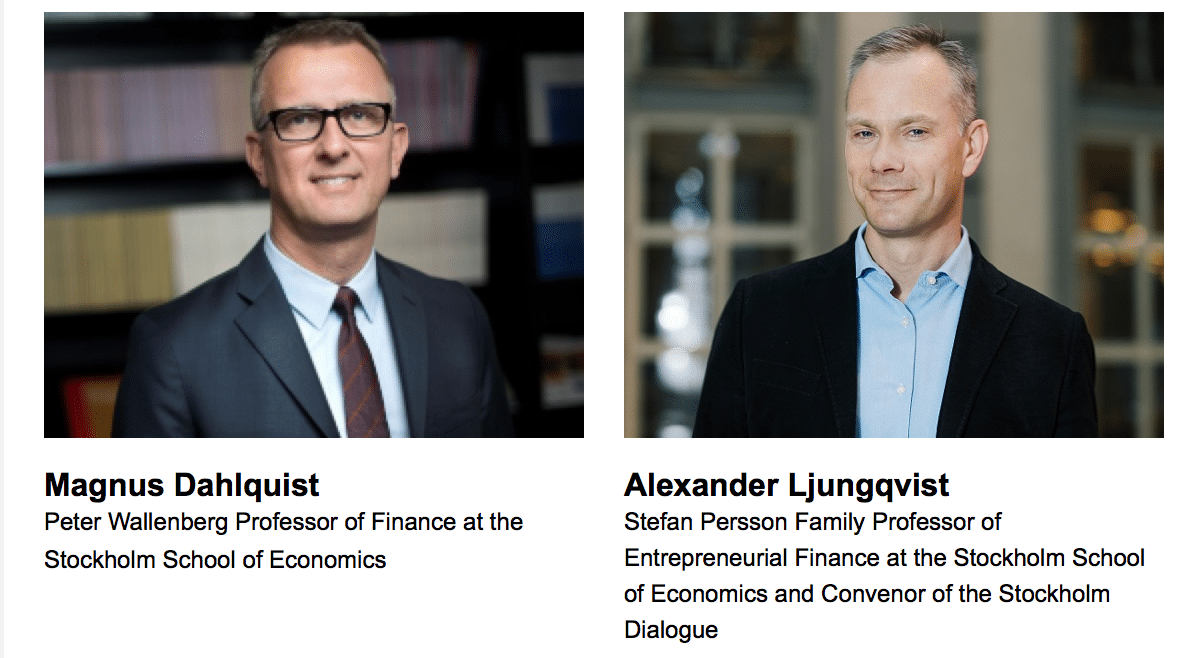
Watch Magnus Dahlquist, Peter Wallenberg Professor of Finance at the Stockholm School of Economics, and Alexander Ljungqvist, Stefan Persson Family Professor of Entrepreneurial Finance at the Stockholm School of Economics and Convenor of the Stockholm Dialogue, present their views on short selling restrictions. They are joined by a panel of internationally acclaimed experts:

Scott Bauguess, director of the Center for Enterprise and Policy Analytics at the University of Texas and former acting chief economist at the U.S. Securities and Exchange Commission

John C. Coffee, Adolf A. Berle Professor of Law and director of the Center on Corporate Governance at Columbia University Law School

Nandini Sukumar, CEO of the World Federation of Exchanges
Read more and register!

Time: 15:30-17:00
Duration: 90 minutes
Call in details: To be able to attend the webinar you need Zoom. If you need to download it you can use this link Zoom
Practical Information
Registration: Click here!
Date: June 30, from 15:30 to 17:00
Webinar: Through ZoomThe number of attendee spots is limited. In case of time conflict, please cancel 24 hours ahead. The webinar will be recorded and available on our website for viewing.Further information
General questions: Hedvig Mattsson, event@houseoffinance.se
Press contact: Sara Ottosson, sara.ottosson@hhs.se


About us

The Swedish House of Finance at the Stockholm School of Economics is Sweden’s national research center for financial economics. It hosts internationally distinguished researchers, and enables financial research and development of the highest quality.

The center serves as an independent platform where academia and both the private and public financial sectors can exchange knowledge, foster new ideas and gain access to a global network of the most prominent researchers in finance.

The Swedish House of Finance is an equally private and government funded, nonprofit, nonpartisan organization. It hosts approximately 70 researchers, consisting of resident and affiliated professors as well as PhD students.

Sweden’s national research center in financial economics

Drottninggatan 98, 111 60 Stockholm
Phone: +46 8 736 91 00
info@houseoffinance.se

Subscribe to HedgeBrev, HedgeNordic’s weekly newsletter, and never miss the latest news!

Our newsletter is sent once a week, every Friday.

HedgeNordic Editorial Team
This article was written, or published, by the HedgeNordic editorial team.

Latest Articles

CABA Offers Another Roll Down the Curve

CABA Capital has launched the fourth iteration of its Flex strategy, a three-year closed-ended AAA-yield premium strategy designed to harvest roll-down and pull-to-par effects...

Even Steven for Nordic CTAs in Mediocre May

May was another month characterized by reversals and cross-asset volatility. Strong momentum in U.S. equities contrasted with directionless moves across other markets, creating a...

Rhenman Doubles Down on Smaller Healthcare Innovators with New Fund

Many of healthcare’s most transformative breakthroughs often originate not from established industry giants, but from smaller companies developing new technologies, therapies, and treatment approaches....

Always Opportunities Applies Traditional Credit to an Underserved Market

The origins of Always Opportunities can be traced back to a bond transaction involving mobility company Voi. What initially brought together founders, venture capital...

HSBC’s Three Decades of Building Hedge Fund Portfolios

Hedge fund investing has become increasingly institutionalized and resource-intensive, requiring access to specialized managers alongside deep due diligence, portfolio construction, risk management, and ongoing...

The Benefits of Multi-Manager Portfolios in CTA Investing

At first glance, CTA investing can appear deceptively homogeneous. Many managers trade the same liquid futures markets and rely on systematic, trendfollowing models that...

Allocator Interviews

In-Depth: Diversification

- Advertisement -

Voices

Request for Proposal

- Advertisement -