

CABA Capital has launched the fourth iteration of its Flex strategy, a three-year closed-ended AAA-yield premium strategy designed to harvest roll-down and pull-to-par effects in Scandinavian mortgage bonds. The latest vintage comes to market in a very different environment compared to the first Flex fund launched in late 2022, when yield spreads were near crisis levels. Despite spreads having normalized since then, CABA Capital believes investors can still achieve attractive returns by taking “another roll down the curve.”
Domiciled in Luxembourg, CABA Flex 4 largely follows the same investment framework as its predecessors, but introduces one notable change: broader currency accessibility. “Everything is the same. Same universe, same strategy,” explains Mette Østerbye Vejen, Chief Executive Officer at CABA Capital. “The difference this time is that we are launching multiple share classes.” Investors can now access the strategy through sterling, U.S. dollar, euro, Danish krone, Swedish krona, and Swiss franc share classes. “That’s the new feature in Flex 4.”
“Everything is the same. Same universe, same strategy. The difference this time is that we are launching multiple share classes.”
Mette Østerbye Vejen, Chief Executive Officer at CABA Capital.
At its core, the Flex strategy seeks to exploit structural spread premiums available in the Scandinavian covered bond market by going long non-callable five-year Danish and Scandinavian covered bonds while hedging away interest-rate exposure using government bonds and interest-rate swaps. The underlying instruments are AAA-rated securities with historically low default risk, while leverage of up to 15 times is applied to amplify what CABA describes as relatively predictable spread returns rather than directional bond exposure. “What we are leveraging is not a five-year bond; it is the spread of a five-year covered bond over a government bond,” explains Østerbye.
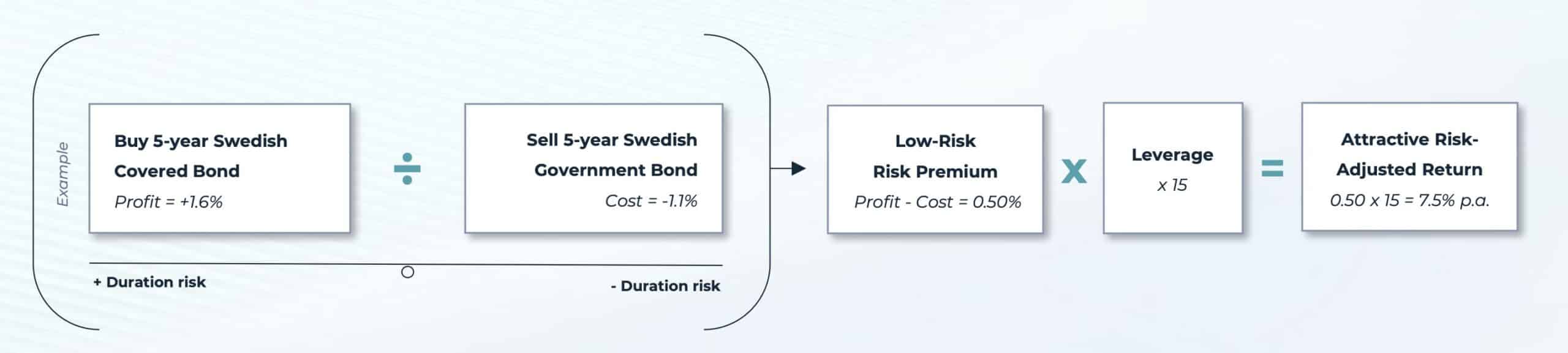
The strategy combines carry income with the natural tendency for bonds to move closer toward par value over time, allowing investors to benefit from both spread compression and pull-to-par effects as bonds roll down the curve. “What really makes these strategies work is the pull-to-par that we love,” says Østerbye. “If you just hold your investment, you will be fine.”
“What really makes these strategies work is the pull-to-par that we love. If you just hold your investment, you will be fine.”
Mette Østerbye Vejen, Chief Executive Officer at CABA Capital.
The first Flex fund launched in December 2022 during a period when spreads were near financial crisis levels and ultimately generated annualized returns of 12.6 percent. Today’s opportunity set looks different. Spreads have compressed and now sit closer to long-term averages, reducing the magnitude of expected returns. Nevertheless, CABA Capital believes Flex 4 can still generate annualized returns of around six percent over its three-year maturity profile. “While spreads have narrowed toward more historical averages, we still feel this is an attractive strategy,” says Østerbye. The firm describes the proposition as seeking equity-like returns from a fundamentally fixed-income risk profile. “We love to say it is equity-like return with a bond-like risk profile. Six percent per annum is within range,” she adds.
One advantage of the Flex structure, according to CABA Capital, is the relatively narrow range of expected outcomes created by stable Scandinavian covered-bond spreads and the pull-to-par dynamics. “Because of the resilience, spreads would have to widen quite significantly before you would experience losses in these strategies after 3 years,” explains Østerbye.
The repeatability of the approach has also become part of the investment case, with many investors participating across multiple vintages as earlier funds have delivered returns in high end of expectations. “If you feel comfortable and want to take another roll down the curve with us, you can either go into this fund or our evergreen fund depending on your risk appetite.”
