

Hedge funds have delivered their strongest first nine months of a US midterm election year since 2006, despite a historical tendency for the second year of a presidential term to produce the weakest returns, according to new research from HFR.
Hedge funds have entered the final quarter of 2026 on a stronger footing than historical US presidential election cycles might suggest. According to a new special report from HFR, the HFRI Fund Weighted Composite Index gained 6.9 percent between January and September, marking the strongest performance over the first nine months of a midterm election year since 2006.
The findings come from HFR’s Hedge Funds and U.S. Presidential Politics: Midterm Edition, which examines hedge fund performance in relation to presidential terms, political party affiliation and congressional control between January 1990 and September 2026.
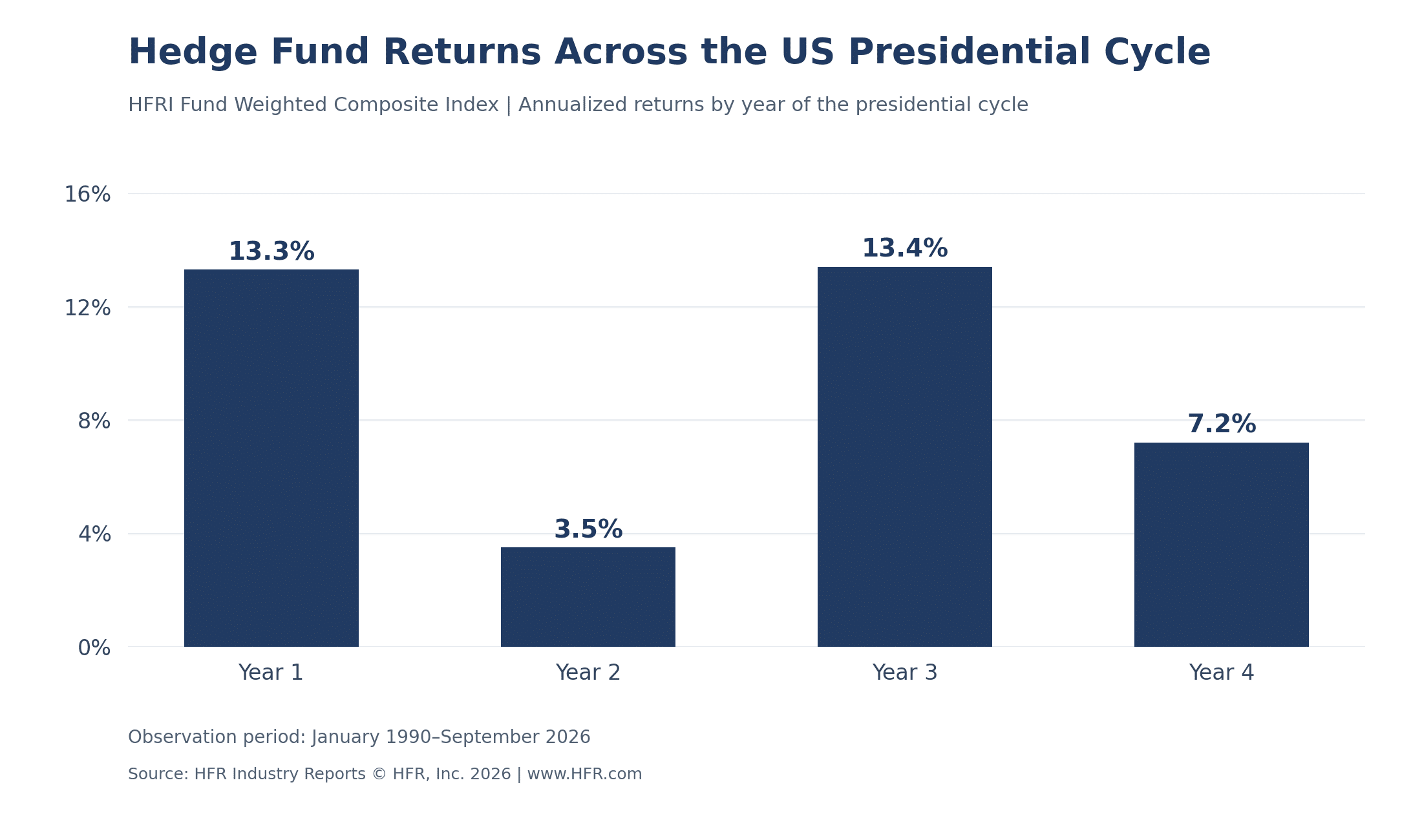
One of the report’s central findings is that the second year of a US presidential term has historically been the weakest for hedge fund performance. Since 1990, the HFRI Fund Weighted Composite Index has generated an annualized return of 3.5 percent during second presidential years, compared with 13.3 percent in the first year and 13.4 percent in the third. Fourth-year returns have averaged 7.2 percent.
The current year has so far departed from that historical pattern. The 6.9 percent return through September compares with a decline of 6.3 percent over the corresponding period in 2022 and a gain of just 1.3 percent in 2018. The strongest January-to-September performance among the midterm years examined was recorded in 2006, when hedge funds advanced 7.1 percent.
A similar, although less pronounced, pattern is visible among Nordic hedge funds. The Nordic Hedge Index (NHX) gained 4.2 percent through September 2026, compared with 6.9 percent for HFR’s global composite. This marks the strongest first nine months of a US midterm election year for the Nordic index since 2006, when it gained approximately 5.5 percent over the corresponding period. Nordic hedge funds recorded more modest gains in 2010, 2014 and 2018, while the index declined sharply during the first nine months of 2022. Differences in index composition and the limited number of election cycles make it difficult to draw conclusions about any consistent midterm effect.
Congressional Control and Hedge Fund Returns
Beyond the presidential election cycle, HFR’s analysis points to differences in performance depending on the composition of Congress.
Since 1990, hedge funds have generated annualized returns of 10.5 percent during periods when the same political party controlled both the Senate and the House of Representatives. That compares with 5.5 percent when control of the two chambers was divided between the parties.
HFR also examines the distinction between unified and divided government, taking the presidency into account. Under Democratic administrations controlling both chambers of Congress, hedge funds have generated annualized returns of 11.3 percent. The corresponding figure for unified Republican governments is 9.4 percent, compared with 8.5 percent under divided government.
What Happens After the Midterms?
HFR’s research also examines how hedge funds have performed in the final quarter of midterm election years, distinguishing between elections that changed congressional majorities and those that left the balance of power unchanged.
The strongest historical fourth-quarter returns have occurred when neither chamber changed majority party. In those circumstances, the HFRI Fund Weighted Composite Index generated an average return of 5.0 percent, compared with 1.3 percent when only the Senate changed control and 0.6 percent when only the House changed control. When both chambers changed majority party, the corresponding return was 2.0 percent.
The historical figures suggest that election outcomes and the resulting political configuration have coincided with materially different return environments. However, the relatively small number of midterm elections since 1990 limits the conclusions that can be drawn, particularly when distinguishing between different combinations of congressional changes.
While HFR’s findings reveal distinct historical return patterns, they do not establish that political outcomes determine hedge fund performance. Economic conditions, monetary policy and market cycles remain important influences on returns.
For hedge fund managers and allocators approaching the November elections, the research offers historical context rather than a reliable guide to future performance.
This dataset and report is provided for informational purposes only. The information contained in the dataset is quantitative in nature and indicates no preference toward, or endorsement of, any political party or economic agenda.
Picture: (c) Harold Mendoza — unsplash.com
